UDIA WA CEO Tanya Steinbeck and Executive Director – Strategy & Policy Sarah Macaulay attended the State Budget Lock Up at Dumas House this morning to receive an overview from the Premier and Treasurer on key elements of today’s budget.
According to the Premier and Treasurer’s addresses at the State Budget Lock‑Up at Dumas House today, Western Australia again enters the new financial year as the strongest performing economy in the nation, despite ongoing global uncertainty. With domestic economic growth revised up and private sector activity driving most of the growth, this ‘responsible’ Budget is framed around keeping WA strong, delivering on the priorities of jobs, health and housing, and ensuing its remains ‘the best place to live, work and raise a family’.
The Treasurer confirmed operating surpluses of $3.5 billion in 2025–26 and $2.4 billion in 2026–27, reinforcing the Government’s continued emphasis on fiscal discipline, economic diversification and reinvestment in enabling infrastructure, health, education and housing.
Central to the Budget is a headline $4.7 billion housing investment, as part of a broader $44.3 billion commitment to health, housing and economic infrastructure over the next four years.
With relatively few surprises, with UDIA WA having welcomed the announcement of Sunday of the key housing measures… the increase of the Housing Enabling Infrastructure Fund (HEIF), targeted funding to unlock priority growth areas and METRONET precincts, additional support for off‑the‑plan and first home buyer (FHB) activity, and measures aimed at improving built form project feasibility and workforce capacity.
The Treasurer also pointed to expectations of a moderating housing market over the forward estimates, with price growth forecast to decelerate as supply responds to these initiatives.
Overall, the 2026–27 Budget reinforces a policy direction to leverage WA’s strong fiscal position to remove the fundamental barriers to housing delivery, continuing to work collaboratively with industry to accelerate new supply across Perth and the regions.
Headline Economic Indicators in the 2026-27 State Budget include:
- WA’s domestic economic growth has been revised up to 3.5 per cent in 2025-26, together with growth of 2.25 per cent in 2026-27
- WA remains the strongest economy in the nation – in the year to February 2026, WA accounted for over 45% of national exports, worth $238 billion, far outpacing the next closest State, Queensland, with just 19% of national exports
- 86% of WA’s economic growth is being driven by the private sector, highlighting the resilience in the WA economy
- Net Debt is expected to hit $34.5 billion by 30 June 2026, $4.5 billion lower than forecast in last year’s Budget and the lowest in the nation
- WA’s unemployment rate remained consistently below historical levels, at 3.7% in 2024-25 and 4% expected in 2025-2026
- Population growth peaked at 3.6% in June 2023 and has moderated since, with growth of 2.2% in September 2025 and expected to average 1.5% over the next four years
- Perth CPI forecast has been upgraded from 3.2% to 4% (annual average growth)
- Surplus of $3.5bn is forecast in 2025-26, $2.4bn in 2026-27, with operating surplus across the forward estimates
Housing related statistics underpinning the State Budget 2026-27 include:
- Perth median house price growth is expected to be 13.5% in 2025-26 and forecast to decrease to 9% in 2026-27 (compared to 18% in 2024-25)
- Building approvals grew 12% over the last year to 25,000
- Housing completions were up 22.9% in 2025 at 23,830 dwellings (46% increase over the last three years)
- Rental vacancy rate was 2.2% in February 2026
- Construction workforce grew to a record 172,000 in February 2026
- Dwelling investmentgrew by 8% in 2025, following growth of 5.9% in 2024-25, supported by increased activity in both new dwelling construction and improvements to existing dwellings (classified as alterations and additions)
Headline spend:
- General government expenses are estimated to total $52.5 billion in 2026-27, an increase of 6.9% across 2026-27 to 2028-29 since release of the 2025-26 Mid-year Review
- $4.7 billion in housing, an increased investment of $10.8 billion investment since 2021
- $44.3 billion investment in the next four years for health, housing and economic infrastructure
- $1 billion on Cost of Living Relief
- $8.9 billion in education and schools
- $2.7b transport investment
- $9.5 billion in regional infrastructure, including $419 million for more than 500 Government Regional Officer Housing (GROH) and key government worker dwellings through the Seven Cities New Build program
Industry related details in the State Budget 2026-27 include:
HOUSING INVESTMENT OVERVIEW
The Budget includes a total investment of $4.7 billion to boost housing supply, diversity and affordability across Western Australia.
Key new investments include:
- $522 million from the Government’s Housing Enabling Infrastructure Fund for Western Power and the Water Corporation to deliver power, water, wastewater and drainage infrastructure required to unlock land for new homes;
- $250 million Pre-Sale Guarantee and $250 million First Home Buyer (FHB) Commercial Financing Fund providing concessional loans, to support new apartment and townhome projects through Keystart;
- $297 million housing tax package, including stamp duty relief for FHBs and to support housing diversity;
- $40 million top up to the Infrastructure Development Fund;
- $1 billion for DevelopmentWA and the Department of Housing and Works to build 1,426 new social and affordable dwellings in partnership with the Commonwealth through the Housing Australia Future Fund;
- $570 million for DevelopmentWA to deliver new residential developments across Perth’s north, south and east and to prepare underutilised land at METRONET station precincts for new, diverse housing opportunities;
- $399 million for key government worker housing including more than 500 homes as part of the Seven Cities initiative;
- $375 million for the upfront construction of 500 affordable homes, to be sold to first home buyers supported by Keystart shared equity loans;
- $234 million to deliver maintenance works to Government residential housing assets including social housing, GROH dwellings and Aboriginal housing;
- $218 million for the Department of Housing and Works to deliver a further 165 social dwellings, refurbishment of 215 social dwellings and the acquisition of land for future builds.
PROPERTY TAXATION
- Total transfer duty is estimated to reach $4.9 billion in 2025-26.
- Duty is forecast to decline by 19% (or $928 million) in 2026-27, reflecting an anticipated moderation in residential property market conditions.
- Duty is forecast to grow by around 4.4% per annum in 2027-28 and 2029-30, reaching around $4.5 billion in 2029-30.
- This reflects the expectation that transactions will recover to more typical per capita levels, house price growth moderates and large commercial transactions normalise to around decade average levels.
- Land tax collection is estimated to be $988 million in 2025-26.
- Total land tax collections are forecast to increase to $1.5 billion in 2026-27, consistent with a lift in unimproved land values and the number of eligible taxpayers.
- Total land tax collections are then forecast to grow by an average of 6% per annum in the outyears, broadly in line with the long-run average rate of growth.
First Home Owner Transfer Duty Concession
As previously announced, for transactions entered into on or after 7 May 2026, FHBs will now receive:
- a transfer duty exemption for established properties valued up to $600,000 (up from $500,000) and a concessional rate of duty for purchases up to $800,000 (up from $700,000 in the Perth and Peel region and $750,000 in other regions); and
- a transfer duty exemption on purchases of vacant land valued up to $450,000 (up from $350,000) and a concessional rate of duty for purchases up to $550,000 (up from $450,000).
This measure is estimated to reduce transfer duty revenue by $197.4 million from 2025-26 to 2029-30, supporting around 6,000 first home buyers into home ownership per annum.
Delink Eligibility Between the First Home Owner Rate of Duty and First Home Owner Grant
Under existing arrangements, eligibility for the first home owner rate of duty for a purchase of vacant residential land is linked to the FHOG cap (increased to $800,000 in this Budget). This means that a first home buyer purchasing vacant land would be ineligible for a duty concession if the combined value of their land and building exceeded the FHOG property value cap, even if the value of the vacant land fell within the first home owner rate of duty thresholds.
The Budget removes this link for transactions entered into on or after 7 May 2026, ensuring that first home buyers purchasing vacant land between the concession thresholds receive a concession as intended, even if they are ineligible for the FHOG.
This measure is estimated to reduce transfer duty revenue by $10.7 million from 2025-26 to 2029-30, supporting around 340 first home buyers into home ownership per annum.
Off the Plan Transfer Duty Concession
As previously announced, the Government has extended the off-the-plan transfer duty concession by two-years, from 30 June 2026 to 30 June 2028.
In addition, for eligible pre-construction and under construction transactions entered into on or after 12 March 2026, the Government has:
- expanded the concession to include off-the-plan dwellings in survey strata schemes such as units and villas, in addition to apartments, townhouses and other build strata developments; and
- increased the concession’s lower and upper property price thresholds to $800,000 and $900,000 (up from $750,000 and $850,000, respectively).
As a result of the changes, eligible pre-construction contracts will receive a 100% concession on properties valued up to $800,000, phasing to a 50% concession for properties valued at or above $900,000 (capped at $50,000). For eligible under construction contracts, the concession phases down from 75% to 37.5%.
This measure is estimated to reduce transfer duty revenue by $73.1 million from 2025-26 to 2029-30 and is expected to encourage housing choice, including for first home buyers and seniors seeking to downsize.
New Foreign Buyers Duty Exemption
A new foreign buyers duty exemption will apply to foreign buyers who add housing supply to the market.
It applies to transactions entered into on or after 7 May 2026 and is designed to support residential development activity that adds housing stock. This differs from the existing exemption offered by the Government, which applies only to significant developments of ten or more dwellings.
Foreign buyers will need to construct and sell new dwellings within two years of the original purchase.
Eligible development activities include:
- purchasing vacant land and constructing a dwelling(s);
- purchasing and completing a partially constructed dwelling(s);
- purchasing land with established property on which more dwellings will be constructed than demolished; and
- repurposing or refurbishing commercial or industrial buildings into residential dwellings.
This measure is estimated to reduce foreign buyers duty revenue by $1.6 million from 2025-26 to 2029-30.
INFRASTRUCTURE FUNDING
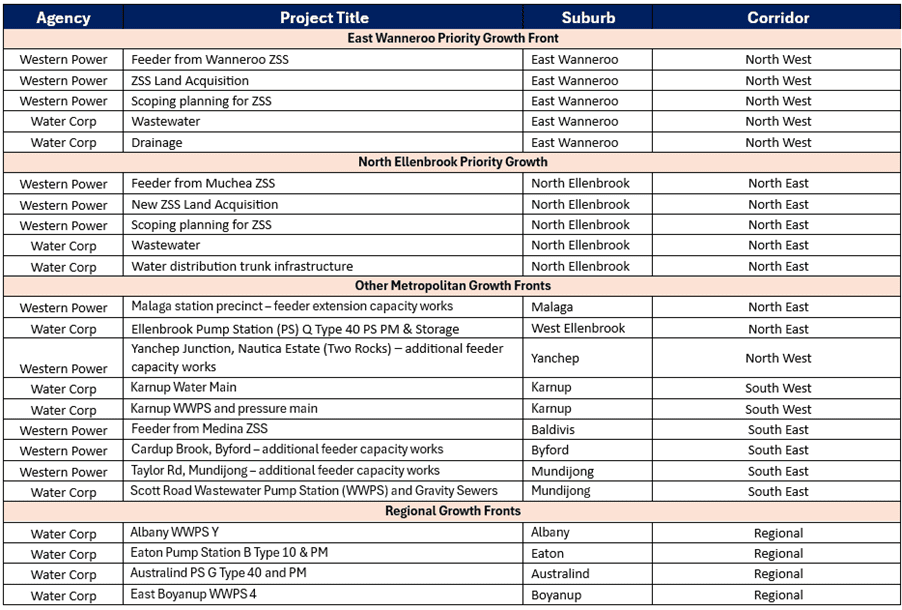
As announced and welcomed by UDIA WA on Sunday 3 May, the HEIF has been increased in this Budget to $665 million, up from the initial investment of $400 million, to continue to deliver infrastructure needed to unlock new land supply. Over the four years, a total of $522 million will be spent to service the priority growth areas.
Of this, over the forward estimates, Water Corporation has been allocated $321.5 million to deliver the water, wastewater and drainage infrastructure, including:
- $140.6 million for North Ellenbrook and East Wanneroo.
- $75 million for priority locations such as Mundijong, Karnup, West Ellenbrook, Albany, Eaton, Australind and Boyanup.
- $26.6 million for METRONET precincts.
Western Power has been allocated $247.3 million under the HEIF which includes:
- $48.5m for new distribution feeders across East Wanneroo, North Ellenbrook and North East Baldivis.
- $100m for activation of METRONET precincts.
- $83.2m for planning, scoping and land acquisition for new substations in East Wanneroo and North Ellenbrook.
This brings Western Power’s total retained dividends from the HEIF to $300 million over 2024-25 to 2029-30.
The HEIF allocations in this Budget include:
Infrastructure Development Fund
To increase residential land supply, DPLH will spend an additional $40 million over the forward estimates to increase the IDF from $80 million to $120 million. Grants from the IDF are available to developers, landowners and local governments to support water and power infrastructure for the development of medium and high-density housing projects.
The IDF will support the delivery of dwellings for first home buyers, with half of the $40 million increase to be funded by the Commonwealth through the 100,000 Homes for First Home Buyers program.
HOUSING SECTOR PRODUCTIVITY & WORKFORCE
Key investments to support the construction sector include:
- $47.5 million to DevelopmentWA in 2026-27 to support the development of Housing and Infrastructure Advanced Manufacturing Facilities located in Neerabup and Kwinana.
- $19.6 million from the Construction Training Fund for an additional 330 places under the Group Training Organisation Wage Subsidy Program.
- $13.1 million to extend the Construction Visa Subsidy Program and Build a Life in WA incentive by 1,100 places.
- $18.7 million to continue low and fee-free courses to train more electricians, plumbers, bricklayers and plasterers.
SOCIAL AND AFFORDABLE HOUSING
The budget includes an investment of $1.5 billion to boost the supply of social and affordable housing across the State. This includes:
- $1 billion to build 1,426 new dwellings, delivered in partnership with the Commonwealth through the Housing Australia Future Fund.
- $218 million for the delivery of a further 165 dwellings, the refurbishment of 215 dwellings and the acquisition of land for future builds to ensure that every Western Australian has access to a secure home.
- $234 million in maintenance and upgrades, bringing underutilised homes back online and improving existing supply.
These investments bring the State’s delivery pipeline to more than 9,800 homes from July 2021 to June 2030.
ENVIRONMENT
The Budget includes a range of investments to protect the environment, including facilitating the energy transition and streamlining approvals, such as:
- $1.4 billion investment to the Clean Energy Fund, including for projects like Clean Energy Link – East which was previously announced as a priority project under the State Development Act 2025.
- $50.8 million to resource PoweringWA to deliver the State’s energy transition, modernising the State’s energy systems to cut emissions and meet future generation needs.
- $5.6 million for the Native Vegetation Policy to deliver priority environmental reforms to streamline approvals processes and improve environmental outcomes.
- $395,000 from the Digital Capability Fund for the WA Vegetation Extent Pilot to continue work on a proof of concept and business case for the use of artificial intelligence to map and track native vegetation across the State.
SMALLER HOUSING RELATED INVESTMENTS
Other funding items listed for DPLH include:
- $6.2 million for resourcing to coordinate the Housing Diversity Pipeline program, and a further $2.3 million for remediation works to support land divestment for new housing.
- $3.8 million to continue the Strategic Projects Team to ensure major strategic projects progress efficiency through planning and land use approvals.
View the State Government Budget Papers here.