The recently released reforms to the State Government’s R-Codes marks another regulatory led push to increase housing diversity in infill locations across Western Australia.
While the laudable intents of the R-Codes reforms is on both code simplification and facilitation of greater levels of infill development, there is a question mark around whether the types of ‘infill’ housing which will be stimulated by (for example) relaxing of minimum lot sizes for subdivision in R20 zones is the most efficient & long-term desirably means to generate new infill housing across WA.
By various measurements the (minimum) target rate of 47% of ‘urban infill’ set out by the current metropolitan planning strategy Perth and Peel@3.5 million has been comprehensively undershot over the last eight years.
According to the State Government’s Urban Growth Monitor 17 (UGM) annual rates of urban infill delivery have fluctuated from a low of 28% in 2013 to a high of 44% in 2020, and recorded 39% in 2024.
Taking this UGM measurement at face value could provide grounds for positivity, with these rates representing relatively strong levels of ‘urban infill’ across Greater Perth – despite consistently missing the 47% metropolitan target level. However, as always the ‘devil is in the detail’, and in this instance it is important to consider the definition of ‘infill’ used by the UGM:
“infill refers to new residential dwellings delivered within urbanized areas, regardless of dwelling type.”
The UGM ‘infill’ measurement therefore includes new detached houses as well as traditional infill typologies of apartments, townhouses and other semi-detached homes (which collectively refers to ‘multi-units’).
While additional (net) detached homes in urbanized areas (often resulting from the subdivision of suburban blocks) are a component of ‘infill’ supply counted in the large Eastern Seaboard capital’s supply monitoring, the contribution of this ‘soft density’ is historically quite modest (i.e. ~10% of total annual infill); with high and medium rise apartments, medium density townhouses, semi-detached homes comprising the bulk of new East Coast ‘infill’ supply.
In WA, approvals for traditional infill typologies have plummeted in the last decade with just 15% of total approvals over 2021-2025 period directed to multi-unit dwellings, with 9% of these approvals for apartments and just 6% for semi-detached stock. This compares unfavorably to the long-running national average of 42% of total approvals for multi-units; with 26% for apartments and 16% for semi-detached dwellings.
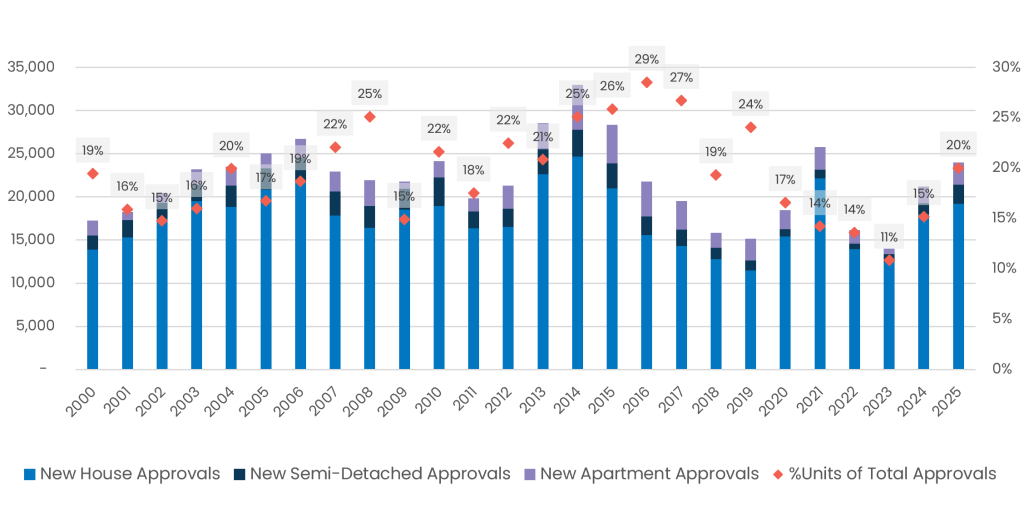
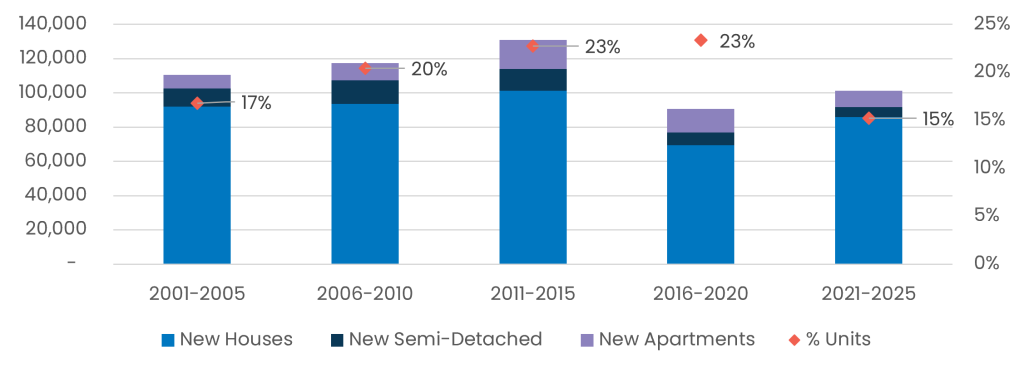
Over the last decade new detached home approvals comprised a remarkably high decade average of 52% of all new dwelling approvals within Western Australia’s principle location for urban infill – the Central Sub-Region of Greater Perth.
The Central Sub-Region includes all nineteen inner and middle ring metropolitan local government areas – including exclusively ‘established urban footprint’ locations for new dwelling supply. By all accounts the Central Sub-Region should be doing the ‘heavy lifting’ for new infill dwelling supply, and indeed over the last decade the Central Sub-Region has recorded 76% of all Greater Perth multi-unit approvals.
However, while the Central Sub-Region has recorded 34,200 multi-unit approvals there has also been 28,900 new house approvals. If we remove annual demolitions (to account for ‘knock-down / rebuild’ approvals with a generous 50% of all new house approval deduction) there have been at least 14,000 net new detached house additions across the Central Sub-Region in the last 10 years.
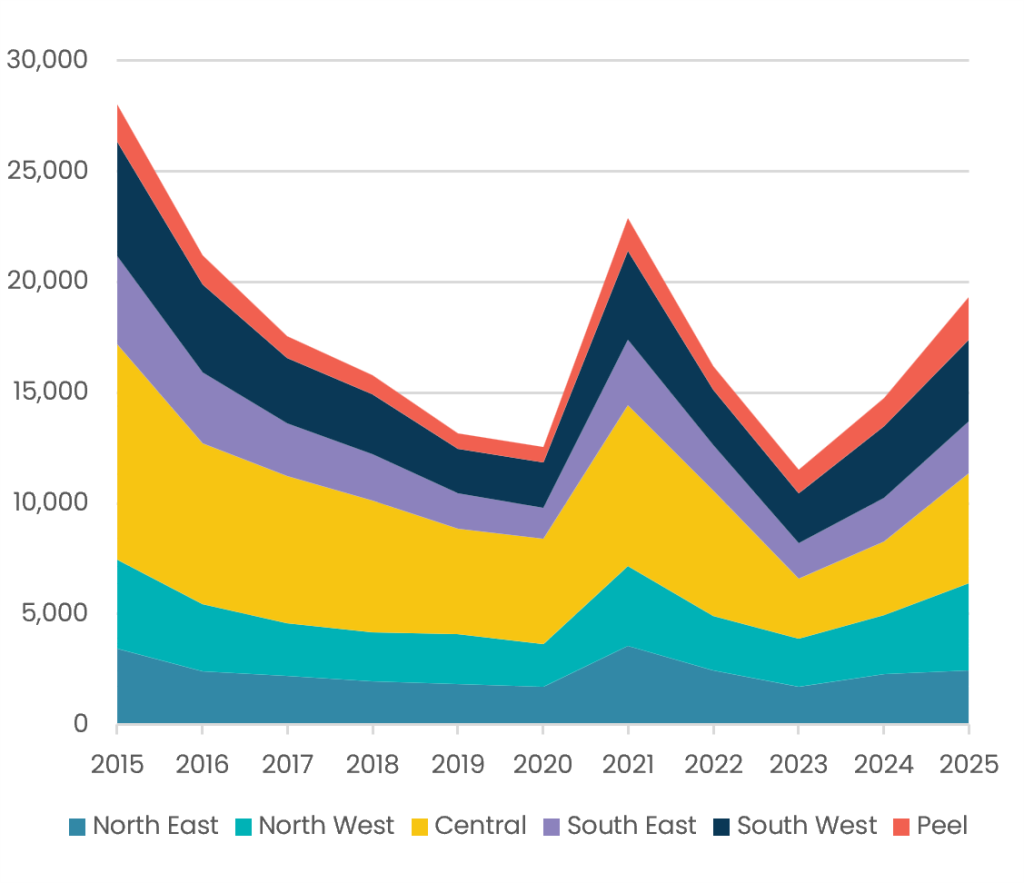
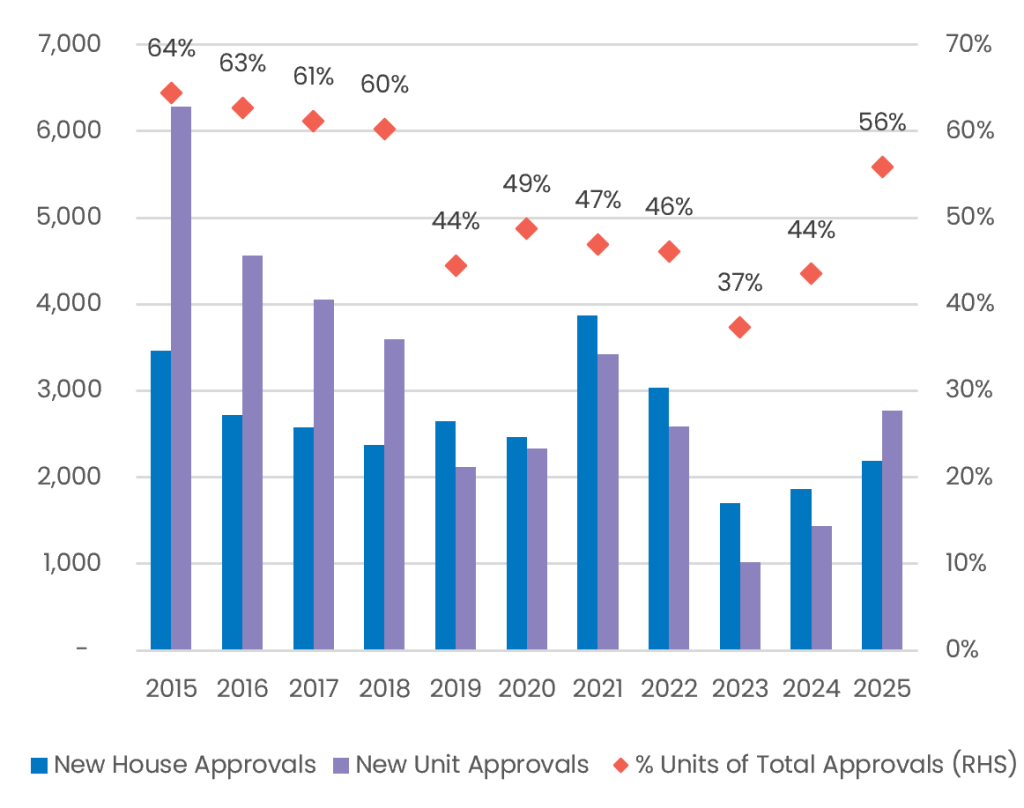
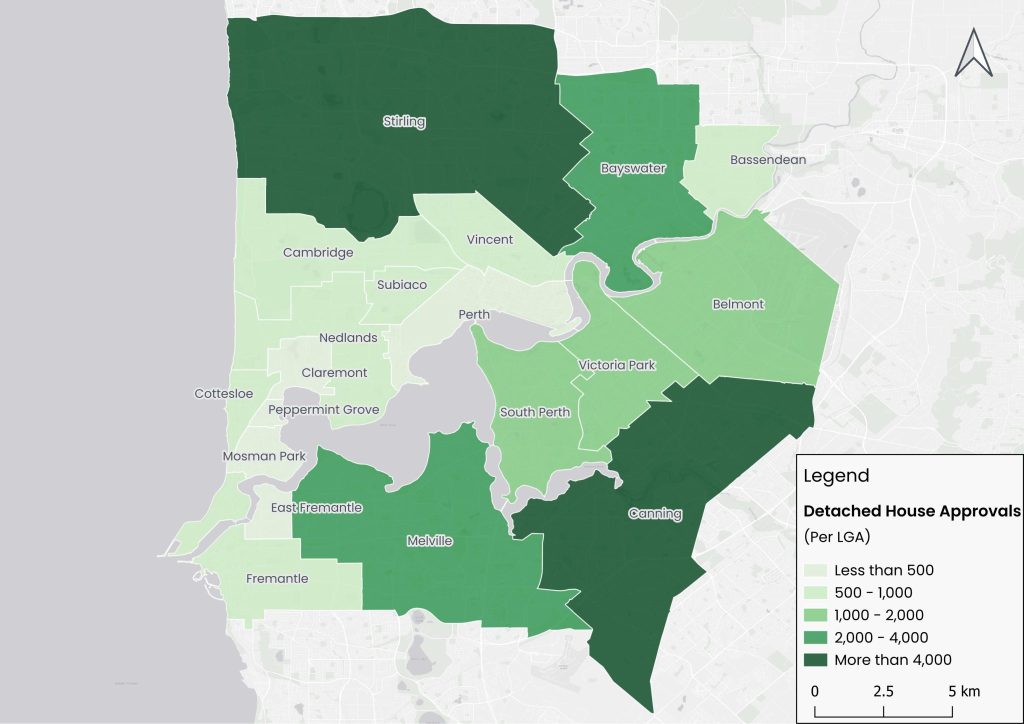
The epicenter for detached house approval activity in the Central Sub-Region has been the City of Stirling which captured almost a third of all new ‘infill’ detached house supply with 8,385 approvals across the last decade, followed by the Cities of Canning (4,330), Melville (3,515) and Bayswater (2,805).
According to government statements regarding adjustments to the R20 density codes (as part of the R-Code reforms) Stirling and Canning are set to be amongst the most impacted by the changes along with outer metropolitan LGAs such as Wanneroo, Joondalup and Cockburn.
There is little doubt that the R-Code reforms will further inflate the volume of detached house infill supply over the coming years, such as emerging from battle-axe subdivisions and other ‘soft density’ additions to the new dwelling supply profile. Whether the R-Code reforms can also stimulate greater levels of new apartment and townhouse development across the Central Sub-Region in particular, as well as into the outer Sub-Regions will be closely watched. The uplift in these traditional infill typologies holds the key to increase housing choice & diversity for existing and future community access.
Warm regards,
Toby Adams, Head of Research (UDIA WA and National)